
The best sports psychology app depends on the job you need it to do. An individual athlete who wants one personalized mental rep before practice needs a different product from a coach assigning a team curriculum, a baseball player combining video and mental work, or an organization delivering its own program.
Our 2026 pick for personalized daily mental training is Athlete Mindset. It combines a short check-in, a recommended mental rep, sport-specific visualization, reflection, and real-time conversations with Aomi, its AI mental performance coach. Champion’s Mind is a stronger fit for a coach who wants a structured lesson library and team accountability. Mind & Muscle is the specialist choice for baseball and softball. Optimize Mind Performance is built for organizations that need a customizable delivery platform. Headspace is the broadest option for general mindfulness, meditation, and sleep.
There is no honest universal winner. The useful question is: Which app matches the mental skill, sport context, and delivery model you will actually use?
Quick Picks
- Best for personalized daily mental reps: Athlete Mindset
- Best for a structured team curriculum: Champion’s Mind
- Best for baseball and softball: Mind & Muscle
- Best for organizations delivering custom programs: Optimize Mind Performance
- Best for general mindfulness and meditation: Headspace
This comparison was checked against each product’s official public information on August 9, 2026. Features and availability can change. I founded Athlete Mindset, so its inclusion is not independent editorial coverage; the criteria and limitations below are published so you can judge the recommendation yourself. No competitor paid to be included, and the links are not affiliate links.
1. Athlete Mindset — Best for Personalized Daily Mental Reps
Best for: Individual athletes who want a short, repeatable mental-training loop tied to their sport, current pressure, and next competition.
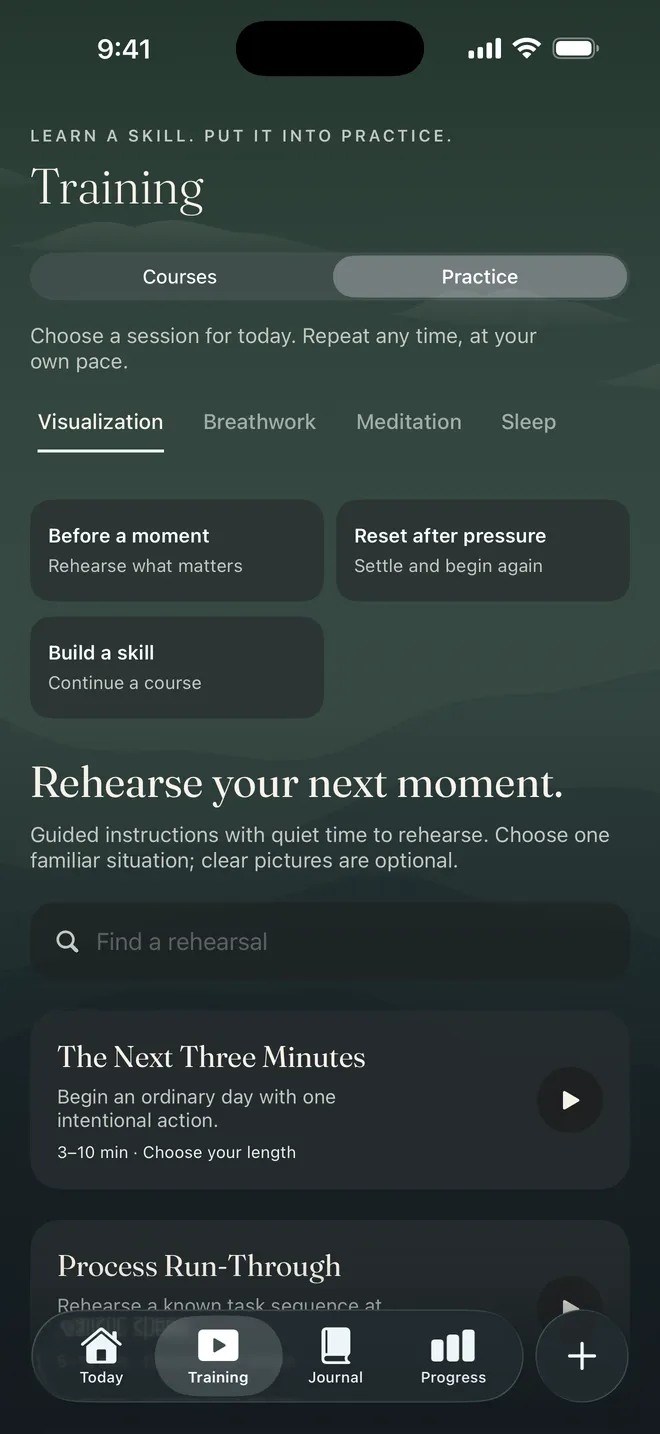
Athlete Mindset starts from the situation the athlete is actually facing. The daily loop moves from a check-in to a recommended mental rep, guided practice, and reflection. The training includes sport-specific visualization, confidence and pressure work, breathwork, quick resets, and real-time voice or chat conversations with Aomi.
That makes it the strongest fit when you want the app to answer, “What should I practice today?” rather than asking you to browse a large library. It can also carry context from recent goals, mental reps, and competition reflections into later coaching conversations.
The limitation is scope. Athlete Mindset is a performance-training product, not clinical mental health care and not a replacement for a licensed sport psychologist, therapist, or emergency support. It currently works best for athletes who want a personal iPhone or iPad practice; a coach looking for a roster-wide assignment dashboard may prefer a team-first platform.
The US App Store showed a 5.0 rating from 15 ratings when checked on August 9, 2026. That is encouraging early feedback, but it is still a modest rating sample and should not be treated as proof of effectiveness.
2. Champion’s Mind — Best for a Structured Team Curriculum
Best for: Coaches and teams that want a large mental-skills program, assigned modules, challenges, streaks, and visible progress.
Champion’s Mind describes hundreds of mental-training techniques covering areas such as confidence, leadership, mental toughness, pressure, injury recovery, and mental health. Its coach dashboard can invite athletes and show team progress, while organization features support larger groups and custom support resources.
This is a strong delivery model when accountability and a shared curriculum matter more than one athlete receiving a deeply individualized session each day. The trade-off is the same one found in any large library: the athlete or coach still needs to choose the right material for the immediate performance problem.
3. Mind & Muscle — Best for Baseball and Softball
Best for: Baseball and softball athletes who want mental training inside a broader sport-specific system.
Mind & Muscle is deliberately narrow. Its public product page combines audio mental training and breathwork with baseball or softball video analysis, drills, game scenarios, arm care, nutrition, goals, team communication, and an AI assistant.
That integration is its advantage. A player can keep mental preparation, skill analysis, baseball IQ, and team work in one sport-specific environment. It is less suitable for an athlete in track, soccer, tennis, swimming, or another sport because the specialization is the point of the product.
4. Optimize Mind Performance — Best for Organizations
Best for: Colleges, national governing bodies, professional academies, high schools, and mental-performance staff who need to deliver and monitor their own program.
Optimize Mind Performance is a platform rather than a simple consumer meditation library. Its public site emphasizes a customizable dashboard, content scheduling, interactive exercises and surveys, engagement analytics, and sport-specific resources for pressure, confidence, motivation, injury, resilience, breathing, visualization, meditation, and sleep.
OMP is the strongest fit in this list when an organization already has staff, content, and a program it wants to scale across teams. An individual athlete looking for an immediate self-serve recommendation may find a consumer-first app easier to start.
5. Headspace — Best for General Mindfulness and Meditation
Best for: Athletes who primarily want meditation, mindfulness, focus, recovery, and sleep support in a broad wellness library.
Headspace for Sport includes material around motivation, training, competition, focus, performance review, rehabilitation, communication, and recovery. Its wider app also covers general meditation and sleep, so it can complement an athlete’s routine beyond sport.
Headspace is not as specific to one athlete’s event, technical cue, competition, or recent performance as a sports-first personalized tool. Choose it when learning and maintaining a general mindfulness practice is the main goal. Choose a sports-psychology app when you need the practice to rehearse the exact pressure, timing, environment, and response of your sport.
How We Compared the Apps
We used six questions that matter after the download screen:
- Who is the product actually built for? Individual athlete, coach, team, one sport, or a large organization?
- What job does it do? Daily practice, curriculum delivery, mindfulness, sport-specific rehearsal, reflection, or a broader training system?
- Does the practice reach the athlete’s real situation? A generic calming audio and a pole vaulter’s first-attempt routine are not the same intervention.
- Is there a repeatable loop? Check-in, practice, reflection, and a clear next action are more useful than an unstructured content shelf.
- Can progress be understood? Useful history should reveal cues, pressure patterns, and completed practice—not only reward a streak.
- Are the safety and privacy boundaries clear? Mental-performance training should not present itself as clinical treatment.
We did not rank apps by the largest content count, the loudest accuracy claim, or a storefront star rating alone. We also did not treat every product as a direct substitute: a team dashboard, a baseball system, and a personal AI coach solve different problems.
What to Look for in Any Sports Psychology App
Sport-specific practice, not generic inspiration
A motivational quote can change your mood for a minute. A mental skill needs repetition in context. A useful app should connect the exercise to your sport, role, upcoming event, and current challenge.
A goalkeeper preparing for penalties needs different imagery from a sprinter rehearsing block clearance. Even two athletes in the same event may need different cues. If every athlete receives the same calming audio, the session may be relaxing without being truly sport-specific.
A repeatable loop, not only a large library
More content is not automatically better. A library of 500 sessions can create another decision when attention is already limited. The strongest pattern is short: check in, choose one skill, complete one rep, reflect, and carry one cue forward.
Visualization that resembles performance
“Imagine yourself succeeding” is only the beginning. Good sports imagery includes physical position, environment, timing, task demands, emotion, and perspective. Those principles are explained in the PETTLEP visualization guide.
Useful imagery should allow pressure, mistakes, and recovery—not only a perfect result. Rehearsing a reset after an error is often more transferable than watching a flawless mental highlight reel.
Fast access in high-pressure moments
Mental skills become more dependable when practiced before they are urgently needed. An app should support ordinary daily reps and make the right routine easy to find before a game, after a mistake, during injury recovery, or while travelling to competition.
If nerves are the main problem, begin with a consistent pre-competition mental routine and rehearse it during normal training.
Reflection you can understand
A streak can support consistency, but it does not prove change. Better signals include how the athlete felt before and after a rep, which situations repeatedly create pressure, which cue helped, and whether the routine was used in real training or competition.
Clear privacy and safety boundaries
Mental-performance reflections can be personal. Check the privacy policy, account controls, and explanation of how conversations or training data are handled. Be cautious when a product is vague about storage or uses sensitive entries for unrelated advertising.
Mental performance training is not treatment for depression, an eating disorder, trauma, or a mental health crisis. Those situations require an appropriately qualified professional or emergency support. A clear boundary is a trust signal, not a weakness.
A Seven-Day Test Before You Decide
Choose one performance situation: losing focus after a mistake, rushing the first attempt, freezing before a serve, or carrying nerves into warm-up. Use the app on at least four of the next seven days, bring one cue into physical practice, and record what happened without forcing a positive result.
At the end of the week, ask:
- Did the app make the next mental action clearer?
- Did the practice resemble the sport situation?
- Could you find the right exercise when attention was limited?
- Did reflection reveal a useful pattern or cue?
- Would you realistically repeat this next week?
The best sports psychology app is the one that turns an idea into a mental rep you can retrieve when the performance gets loud.
Sondre Guttormsen is a two-time Olympian, NCAA champion pole vaulter, and Princeton psychology graduate. He founded Athlete Mindset to make practical mental performance training available to more athletes.