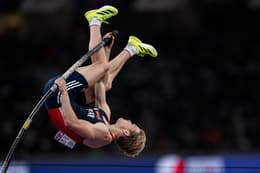
 Sondre Guttormsen

Use Aomi or a guided session to practice what you are reading.

Every elite athlete I've competed against has one thing in common: a pre-competition routine they follow with discipline. Not out of superstition — but because a consistent sequence of cognitive and physical preparation steps shifts the nervous system from anxious anticipation into focused execution.
I learned this empirically before I understood the science. Early in my career, I arrived at competitions consumed by outcome-focused thinking — what place I needed, what height I had to clear, what the other vaulters were doing. My warm-up was inconsistent. I'd perform brilliantly in training and poorly in competition. The difference wasn't fitness or technique. It was mental preparation — or the absence of it.
Here's the routine framework I've developed over years of competing at NCAA Championships and the Olympic Games, cross-referenced with what the mental performance training literature supports.
The Neurological Basis of Pre-Performance Routines
Pre-competition routines serve three evidence-based functions in the central nervous system:
1. Cognitive resource conservation. When the behavioral sequence preceding competition is automated, the prefrontal cortex is freed from allocating attentional resources to logistical decisions. This cognitive economy is well-documented in decision-fatigue research: Baumeister et al. (1998) demonstrated that self-regulatory acts — including deliberative decision-making — deplete a shared cognitive resource, reducing subsequent performance on tasks requiring executive function. A routine eliminates dozens of small decisions during the most cognitively demanding period of the competitive day.
2. Classical conditioning of performance states. Through repeated association, a routine becomes a conditioned stimulus that elicits a readiness response from the autonomic nervous system. The theoretical basis is Pavlovian: repeated pairing of a behavioral sequence (CS) with high-quality performance (US) trains the nervous system to enter performance mode upon initiation of the routine. Cotterill (2010) identifies this conditioned response as the primary mechanism through which routines reduce variability in self-paced sport execution.
3. Arousal regulation within optimal zones. Anxiety and competitive excitement share the same physiological signature — elevated heart rate, cortisol release, heightened sympathetic nervous system activation. The difference between choking and excelling is not the presence of arousal, but whether it falls within the athlete's Individual Zone of Optimal Functioning (Hanin, 2000). A well-designed routine includes explicit arousal management strategies that channel physiological activation into focused performance rather than disorganized panic.
The Framework: Night Before Through Competition
The Night Before
Review process goals, not outcomes. Spend 10 minutes reviewing your performance plan — the specific technical and tactical elements you intend to execute. This should be process-oriented: not "I want to win" but "I want to maintain acceleration through the last three steps of my approach." Filby et al. (1999) found that athletes who used a combination of process and performance goals outperformed those who focused exclusively on outcome goals.
Eliminate logistical uncertainty. Lay out every piece of equipment, prepare nutrition, confirm the travel plan and schedule. Each unresolved logistic is a potential cortisol trigger the following morning. The goal is to remove all variables that could create anticipatory stress.
Accept disrupted sleep. Research by Juliff et al. (2015), surveying 283 elite athletes, found that 64% reported impaired sleep quality before major competitions. The most common disruptors were cognitive anxiety (thoughts about the upcoming event) and unfamiliar sleeping environments. If this happens to you, accept it. Lying in bed with eyes closed provides substantial physiological restoration even without sleep onset (Leproult & Van Cauter, 2010). Adding anxiety about not sleeping compounds the arousal problem — a phenomenon sleep researchers term "sleep effort" (Broomfield & Espie, 2005).
Morning Of
Maintain behavioral normalcy. Don't eat differently, don't wake earlier than necessary, don't alter your caffeine routine. Novelty is a stressor. Familiarity produces a parasympathetic baseline state. Research on pre-competition routines consistently identifies consistency as the most important variable — more important than the specific content of the routine (Moran, 1996).
Restrict information intake. This is not a discipline exercise — it's a cognitive bandwidth strategy. Every piece of content consumed (social media, news, text conversations) requires processing by working memory, which has strictly limited capacity (Cowan, 2001). Protecting that bandwidth for competition is a strategic allocation decision, not an act of asceticism.
Structured visualization (5–10 minutes). Run through your performance in real time, from warm-up through the key execution moments. Use first-person (internal) perspective, which Jeannerod (1994) demonstrated produces stronger premotor cortex activation than third-person (external) imagery. Include the target emotional states: calm confidence, sharp focus, controlled aggression. The imagery should be functionally equivalent to performance — matching the PETTLEP criteria of Physical posture, Environment, Task, Timing, Learning level, Emotion, and Perspective (Holmes & Collins, 2001).
At the Venue (2–3 Hours Before)
Arrive early enough to prevent rushing. Time pressure elevates cortisol through activation of the hypothalamic-pituitary-adrenal (HPA) axis. Once the cortisol response is triggered, it takes 60–90 minutes for levels to return to baseline (Dickerson & Kemeny, 2004). Arriving with margin eliminates this physiological cost.
Physical warm-up with attentional progression. The warm-up is not merely a musculoskeletal preparation — it is a continuation of the mental routine. Structure it as an attentional funnel: begin with broad external awareness (scanning the venue, settling in), progress to narrowed external focus (sport-specific drills), and converge on internal-narrow focus (individual technical cues). This progression mirrors Nideffer's (1976) attentional style model and primes the brain for the focus demands of competition.
Site-specific visualization. At the venue, spend 2–3 minutes integrating environmental details into your mental imagery. Where is the crowd? What does the surface feel like? What will you see from the starting position? This environmental encoding strengthens the functional equivalence between imagery and subsequent real performance (Holmes & Collins, 2001).
30 Minutes Before
Narrow attentional focus. This is the transition from broad preparation to immediate task execution. Identify the first three technical elements you need to execute. Focus exclusively on those. The research on attentional narrowing under pressure (Easterbrook, 1959) suggests that arousal naturally constricts the attentional field — a well-designed routine leverages this effect rather than fighting it.
Controlled breathing protocol. Box breathing (4-second inhale, 4-second hold, 4-second exhale, 4-second hold) stimulates vagal tone, activating the parasympathetic nervous system and lowering heart rate toward the athlete's optimal performance range. Three minutes is typically sufficient to produce measurable heart rate variability shifts (Lehrer & Gevirtz, 2014). Alternative protocols include 4-7-8 breathing and resonance frequency breathing — the critical variable is the extended exhale phase, which directly modulates vagal activity.
Specific instructional self-talk. "I'm going to do great" is too vague to prime motor execution. "My hips stay high at takeoff" or "I attack the first 50 meters" provides the motor system with concrete cues that influence subsequent movement patterns. Hatzigeorgiadis et al. (2011) found that instructional self-talk produced its largest effects (d = 0.67) when the cues were task-specific rather than generic. The cue should match the technical priority for that particular competition.
During Competition
Between-attempt reset protocol. Return to the breathing pattern. Do not analyze the previous attempt — real-time self-evaluation during competition activates the analytical prefrontal networks that compete with the procedural motor systems needed for skilled execution (Masters, 1992). The post-hoc analysis belongs after competition, not during it.
Trained reset cue. If something goes wrong, deploy a conditioned reset — a brief physical gesture paired with a single deep breath that signals the nervous system to transition from the previous attempt to the next. Mine is two taps on my thigh and one controlled exhale. The specific cue is irrelevant; what matters is that it has been trained through hundreds of repetitions in practice, establishing it as a reliable conditioned stimulus for cognitive resets.
Principles for Building Your Own Routine
The specific content of your routine should be individualized to your sport, personality, and competitive context. But the structural principles are empirically consistent:
- Consistency over novelty. The power of a routine derives from repetition. Use the same sequence in training that you use in competition. The routine practiced 200 times in training will function automatically under competitive pressure; the one attempted for the first time at a championship will not.
- Internal locus of control. Every element of the routine must be under your direct control. "Listen to my warm-up playlist" works. "Get encouragement from my coach" does not — external dependencies introduce variability and potential disruption.
- Flexible timing, rigid sequence. If your standard warm-up takes 45 minutes but today you have 30, compress it proportionally — but preserve the order. The sequence is the conditioned stimulus, not the duration.
- Progressive training. Practice the routine in low-stakes contexts first: regular training, scrimmages, intrasquad competitions, early-season events. By the time you deploy it at a major championship, it should be automatic — requiring no conscious effort to initiate or maintain.
The Gap Between Physical and Mental Warm-Ups
Physical warm-up routines are universal in sport. Mental warm-up routines are not. This asymmetry is striking given the evidence base: the same meta-analyses that validate physical warm-ups for injury prevention and performance enhancement (Fradkin et al., 2010) find comparable effect sizes for mental preparation protocols.
The visualization, breathing, and self-talk components of a pre-competition routine are skills — they improve with deliberate practice, just as any motor skill does. An athlete who only visualizes before championships will find it effortful and ineffective. An athlete who visualizes three times per week throughout the season will find it natural and automatic when the competitive stakes are highest.
This is what we designed Athlete Mindset to address. The app delivers structured, AI-guided visualization sessions and breathwork training that athletes can integrate into their weekly training schedule — so that when competition day arrives, the mental preparation component is practiced, automatic, and reliable.
Sondre Guttormsen is a two-time Olympian (Tokyo 2020, Paris 2024), Norwegian pole vault record holder (6.06m indoor), 3x NCAA Champion, and Princeton psychology graduate. He founded Athlete Mindset to make mental performance training accessible to every athlete.
References
- Baumeister, R. F., Bratslavsky, E., Muraven, M., & Tice, D. M. (1998). Ego depletion: Is the active self a limited resource? Journal of Personality and Social Psychology, 74(5), 1252–1265.
- Broomfield, N. M., & Espie, C. A. (2005). Towards a valid, reliable measure of sleep effort. Journal of Sleep Research, 14(4), 401–407.
- Cotterill, S. T. (2010). Pre-performance routines in sport: Current understanding and future directions. International Review of Sport and Exercise Psychology, 3(2), 132–153.
- Cowan, N. (2001). The magical number 4 in short-term memory: A reconsideration of mental storage capacity. Behavioral and Brain Sciences, 24(1), 87–114.
- Dickerson, S. S., & Kemeny, M. E. (2004). Acute stressors and cortisol responses: A theoretical integration and synthesis of laboratory research. Psychological Bulletin, 130(3), 355–391.
- Easterbrook, J. A. (1959). The effect of emotion on cue utilization and the organization of behavior. Psychological Review, 66(3), 183–201.
- Filby, W. C. D., Maynard, I. W., & Graydon, J. K. (1999). The effect of multiple-goal strategies on performance outcomes in training and competition. Journal of Applied Sport Psychology, 11(2), 230–246.
- Fradkin, A. J., Zazryn, T. R., & Smoliga, J. M. (2010). Effects of warming-up on physical performance: A systematic review with meta-analysis. Journal of Strength and Conditioning Research, 24(1), 140–148.
- Hanin, Y. L. (2000). Individual zones of optimal functioning (IZOF) model. In Y. L. Hanin (Ed.), Emotions in Sport (pp. 65–89). Human Kinetics.
- Hatzigeorgiadis, A., Zourbanos, N., Galanis, E., & Theodorakis, Y. (2011). Self-talk and sports performance: A meta-analysis. Perspectives on Psychological Science, 6(4), 348–356.
- Holmes, P. S., & Collins, D. J. (2001). The PETTLEP approach to motor imagery. Journal of Applied Sport Psychology, 13(1), 60–83.
- Jeannerod, M. (1994). The representing brain: Neural correlates of motor intention and imagery. Behavioral and Brain Sciences, 17(2), 187–202.
- Juliff, L. E., Halson, S. L., & Peiffer, J. J. (2015). Understanding sleep disturbance in athletes prior to important competitions. Journal of Science and Medicine in Sport, 18(1), 13–18.
- Lehrer, P. M., & Gevirtz, R. (2014). Heart rate variability biofeedback: How and why does it work? Frontiers in Psychology, 5, 756.
- Leproult, R., & Van Cauter, E. (2010). Role of sleep and sleep loss in hormonal release and metabolism. Endocrine Development, 17, 11–21.
- Masters, R. S. W. (1992). Knowledge, knerves and know-how: The role of explicit versus implicit knowledge in the breakdown of a complex motor skill under pressure. British Journal of Psychology, 83(3), 343–358.
- Moran, A. P. (1996). The Psychology of Concentration in Sport Performers: A Cognitive Analysis. Psychology Press.
- Nideffer, R. M. (1976). Test of attentional and interpersonal style. Journal of Personality and Social Psychology, 34(3), 394–404.
One useful idea. One repeatable rep.
Build a mental routine you can return to when the moment gets loud.